

Counterintuitive
Antivisions, Antihabits and the case for not being optimised.

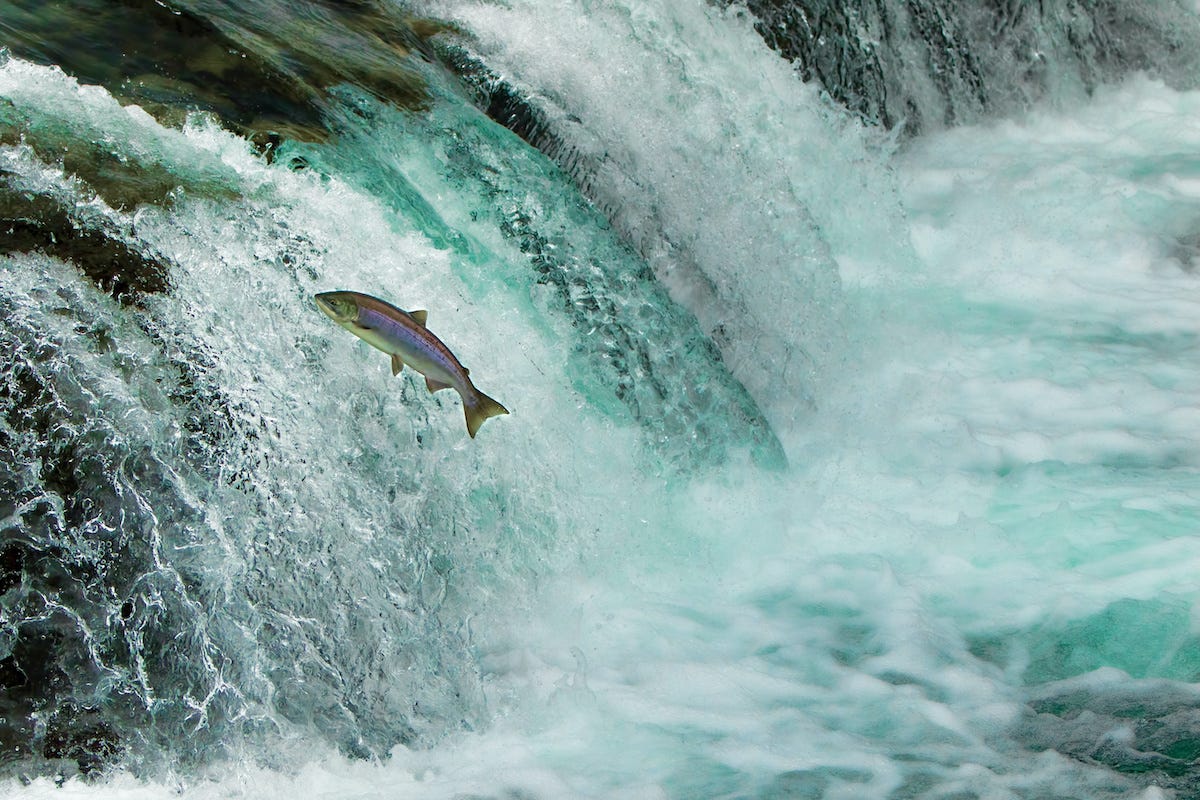
Sometimes the answer is to swim upstream.
Let’s countermand some conventional wisdom - a dystopian vision, less optimisation and the case for throwing some of your habits (even the good ones) out the window on occasion.
AntiVision.
I can’t remember whether I came across this idea from George Mack or Gurwinder Bhogal. Good news for you, it doesn’t matter because you should be following/reading both of them. So go do that once you’re done here. Anyway, back to having an AntiVision.
Apparently, not having a clear goal, a star-spangled personal vision complete with mood board, brand colour guidelines and a media kit is a crime amongst the highly successful. At least on social media. And I get it, there is value in having a North Star. An X marks the spot, otherwise you can easily find yourself wandering about as the years flit by and suddenly it’s a random Tuesday in March, 2032 and you realise that much of what you thought you might have wanted is ‘suddenly’ no longer within your grasp or capacity.
So yes a vision can be good but what if you don’t know what you want yet? What if you change your mind mid-vision? What if the goal posts move and the vision gets sidetracked or derailed or becomes completely irrelevant because you’ve had kids or moved country or your job no longer exists or you realise you actual hate what you thought you would love. What if you fail, what if it becomes impossible or comes with a price tag that you simply cannot or will not pay? How do I find a vision amongst all of that?
This is where an Anti Vision can help.
“If nothing changes in the next five years, what does your average Tuesday look like?”
Take a moment to truly think about the answer to that question.
Now make it ten years.
What have you missed out on? What have you tolerated? Who have you not become? If you woke up tomorrow only to find that five years had passed and your life looked exactly the same as it did yesterday how would you feel?
This is what’s at stake.
Not just who you could be but the crushing knowledge that you have not become.
This Anti Vision is the negative yield. The manifestation of the inverse field of your dreams.
It can be terrifying and that’s kind of the point.
You now have an incentive, an AntiVision that is untethered to what you might want to do but is anchored to what you most definitely do not want to do.
From here the direction can only be forward.
The dreams and visions may change as the days progress, and that’s just fine. I’d argue that that is not only healthy but far more realistic. In all likelihood, even if in five or ten years you deem yourself to be successful in creating the average Tuesday of your dreams, it will probably look nothing like you thought it would.
Welcome to the human experience.
Sometimes knowing what you definitely do not want can be the most important step.
UnOptimised.
“Optimisation is a great servant but a terrible God” - 0xsmac (from Semi-Lucid Thoughts on substack)
Rationally, optimisation is a great idea. There are entire industries built around it. Some are incredibly powerful, like the Japanese concept of Kaizen, continuous and relentless improvement. Others are a plague upon humanity, like the tsunami of influencers on the socials posting endless reels of the their supposedly elite morning routines. Routines that span the gamut from the sublime to the ridiculous.
But there is a point of diminishing returns. A threshold where your optimised life is technically better but subjectively worse.
A hyper-optimised life can be both brittle and a thief.
Brittle in that it carries the psychological burden of what happens when you can’t be optimised. What happens when you didn’t get your red light mask therapy done for the day? Or you couldn’t get your 8 hours of sleep, or your sleep pod won’t work and your bed it two degree too hot? How much of a problem does this become? Was all that stuff about keeping you optimised or about staving off impending existential crises?
A thief in the sense that it can steal the opportunity for meaning. For raw experience. A highly optimised life by definition is low risk, highly efficient. A safe, smooth, known space. To steal from Alex Hutchinson (The Explorers Gene) you have denied yourself the potential bonus that comes with exploring. Meaning and experience is not found in the safe and featureless lands of the well known and highly curated. It is found at the messy margins, where risk and inefficiency and chance and chaos combine to give colour and shape and meaning to the every day.
Some things are worth doing ‘poorly’.
Many of you will have heard of Bryan Johnson and his longevity protocol as he spends millions and seemingly devotes every second of his day to the search to live forever. An objectively worthy goal. My first question is whether it’s subjectively worth it? Is Bryan happy? Is there more meaning in his days than simply doing whatever it takes to get more days?
Is this a call to live your life in total chaos and optimise nothing at all? Far from it.
What I am suggesting is that there is a bonus in not nailing down and refining every variable. Life was meant to be somewhat messy, Nature works that way. Be messy, sometimes look like a fool, risk failure, learn, get out of bounds. This is where the highest rate of return resides. Even the venture capitalists know this - unicorns aren’t found in the well-established. They are found out in the wild.
So yes, get your sleep, consume your creatine and have some structure. These are worthwhile pursuits.
But on the regular just ensure that that which is supposed to serve you has not surreptitiously become your God.
Anti Habits
I’ve talked about anti habits (you can find that piece here) but given that the length of this piece may already be pushing some friendships we’ll keep it fairly high level.
Good habits are good - they reduce cognitive load (by automating activities) make life easier to navigate and reduce the likelihood of ‘sub-optimal’ outcomes (like no doing what you should’ve done).
Bad habits are bad (thanks Captain Obvious) - from endless doom scrolling every night to those sneaking extra few snacks that pepper your day.
Hidden habits are hidden - and they account for 40-45% of all of our habits. The subconscious, deeply ingrained habits that we simply don’t notice, driven by psychological bias and behavioural programming.
So why do you need anti habits?
“The mind seeks comfort but the soul yearns for change” - Alan Watts
The system rewards discomfort, children know this implicitly. Exploration, play, adventure. It not only drives learning and builds a body of knowledge based on new experience, it fosters neuroplasticity. That potential discomfort in the short term as we struggle with something new or a behaviour we are unaccustomed to, drives new neuronal connections, upgrades the ‘wet ware’ in your cranium.
Some habits have to be broken in order for growth to occur. Athletes and coaches know this - if you only ever do the same workout, over and over, you experience the law of diminishing returns. The body figures out what’s going on and optimises for it. Adaptation slows and finally stalls.
Exploration expands the experiential map and drives new adaptations.
Train at night or the middle of the day, add load, change pace, change terrain.
Drive a different way to work, maybe catch the train or (heaven forbid) walk.
Start getting up early, or take mornings off and work the evenings.
Test the system - does this habit still serve me or have I simply become comfortable in it’s warm embrace. Is the habit still valid? Did you even realise that you had that particular habit? (friends and loved ones can be helpful to point out some of those).
The Soul Yearns for Change
Sometimes the answer is to push the conventional wisdom aside, not always and forever, but from time to time you have to test the system, push the boundaries and explore the unknown areas on the map.
Swim upstream, not because all your friends are but because your soul demands it.
While I’m active on Substack, here’s some other places you can find me
Books:
Buy Direct here (Australia Only)
View on Amazon. (Everywhere else)
Free resources:
Follow me on:
Instagram: https://www.instagram.com/the.rogue.scholar/
LinkedIn: https://www.linkedin.com/in/paul-watkins-92125499/
If you’re looking for a speaker for your next conference, you can contact me here
https://www.paulwatkins.com.au/
https://bespokespeakers.net
https://www.corporatespeakersaustralia.com